
 EN
EN
 DE
DE  ES
ES  TR
TR  ID
ID  RU
RU  JA
JA  KO
KO 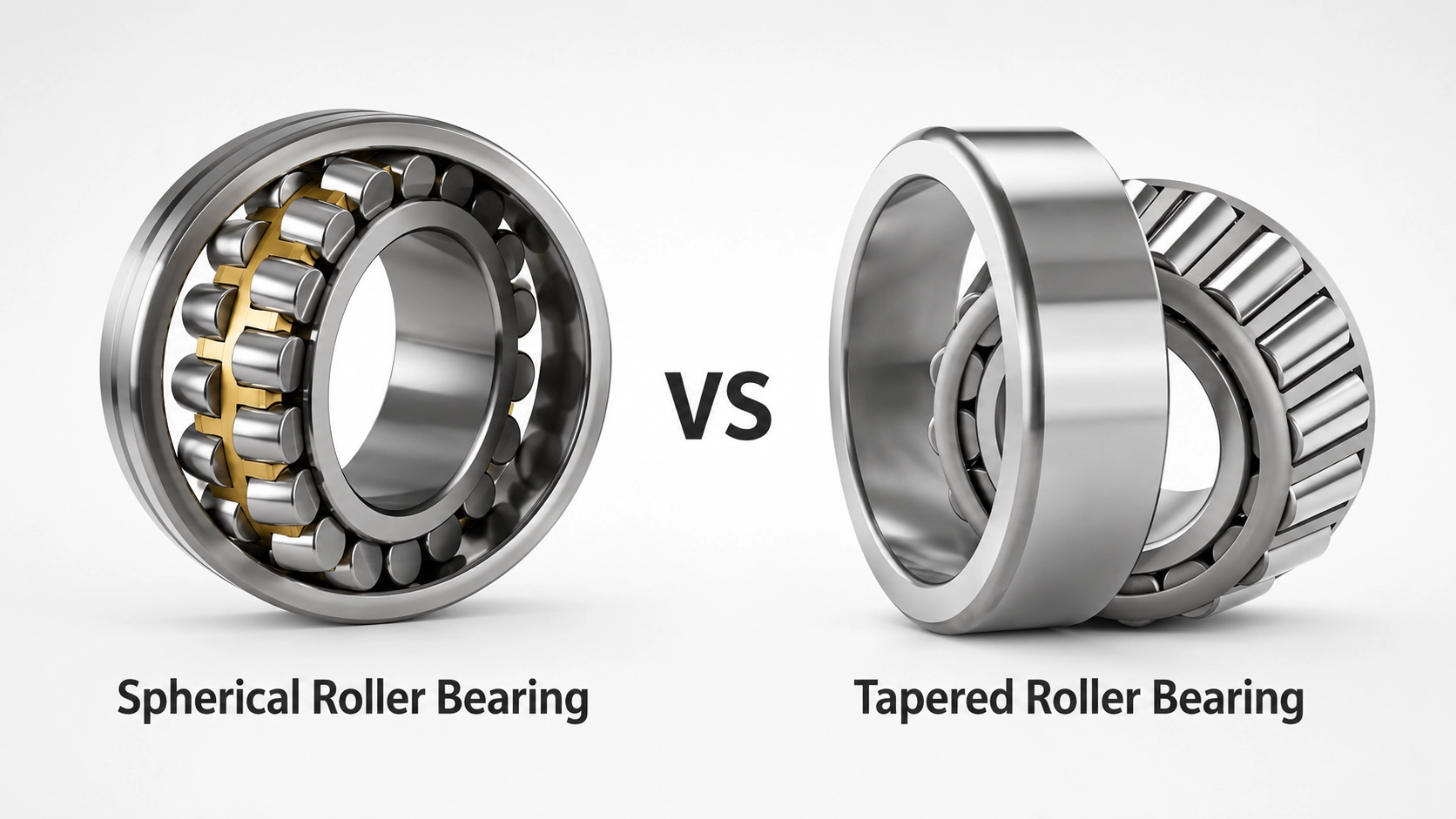
Similar Heavy-Duty Intent, Different Bearing Logic
Spherical roller bearings and tapered roller bearings both appear in heavy industrial equipment, but they solve different problems. A spherical roller bearing is usually chosen for misalignment tolerance and heavy radial load with some axial capacity. A tapered roller bearing is usually chosen for combined radial and axial load where the bearing arrangement can be set and controlled.
For RFQ review, the right question is not “which type is better?” It is “what does the shaft position need to control?”
Quick Comparison
| Selection Point | Spherical Roller Bearing | Tapered Roller Bearing |
|---|---|---|
| Misalignment tolerance | Strong self-aligning capability | Limited; alignment and setting matter |
| Radial load | High | High |
| Axial load | Moderate to high depending arrangement | High in one direction; pairs can handle both directions |
| Bearing setting | Usually not set by preload in the same way | Setting/preload/endplay is a key design factor |
| Common mounting | Cylindrical or tapered bore, adapter sleeve options | Cup and cone arrangement, matched pair when needed |
| Typical use | Crushers, screens, paper rolls, fans, conveyors | Gearboxes, reducers, wheel-style hubs, combined-load shafts |
When to Choose a Spherical Roller Bearing
Choose a spherical roller bearing when the position has shaft deflection, housing distortion, or misalignment risk. This is common in mining equipment, paper machine rolls, conveyors, fans, and heavy mill support positions.
Spherical roller bearings also suit adapter-sleeve mounting, clearance-controlled fits, and heavy radial-load replacement positions. If the current bearing marking includes suffixes such as K, C3, C4, CA, CC, MB, or W33, send the full suffix with the RFQ.
Relevant product details: Spherical roller bearings.
When to Choose a Tapered Roller Bearing
Choose a tapered roller bearing when combined radial and axial load must be controlled through a cup and cone arrangement, or when the equipment design expects bearing setting. Gearboxes, reducers, hubs, and some heavy drive positions often use tapered roller bearings because axial control is part of the arrangement.
For RFQ review, send the cup reference, cone reference, matched set requirement, load direction, speed, and application. A partial number can easily cause quote ambiguity.
Relevant product details: Tapered roller bearings.
Common Selection Mistakes
- choosing a tapered roller bearing where shaft misalignment is the main failure driver
- choosing a spherical roller bearing where precise axial setting is required
- quoting only the model number without suffix, cup/cone reference, or application
- treating two bearing types as interchangeable without checking housing and shaft arrangement
- ignoring speed, lubrication, and temperature when comparing alternatives
RFQ Details to Send
Before asking TFL Bearing to review a bearing type choice, prepare:
- current bearing model and full suffix or cup/cone references
- shaft speed and load direction
- axial load or endplay/preload requirement if known
- misalignment, shaft deflection, or housing condition
- application: gearbox, reducer, fan, conveyor, crusher, paper machine, or other equipment
- quantity, destination, and required documents
Useful next pages: