
 EN
EN
 DE
DE  ES
ES  TR
TR  ID
ID  RU
RU  JA
JA  KO
KO 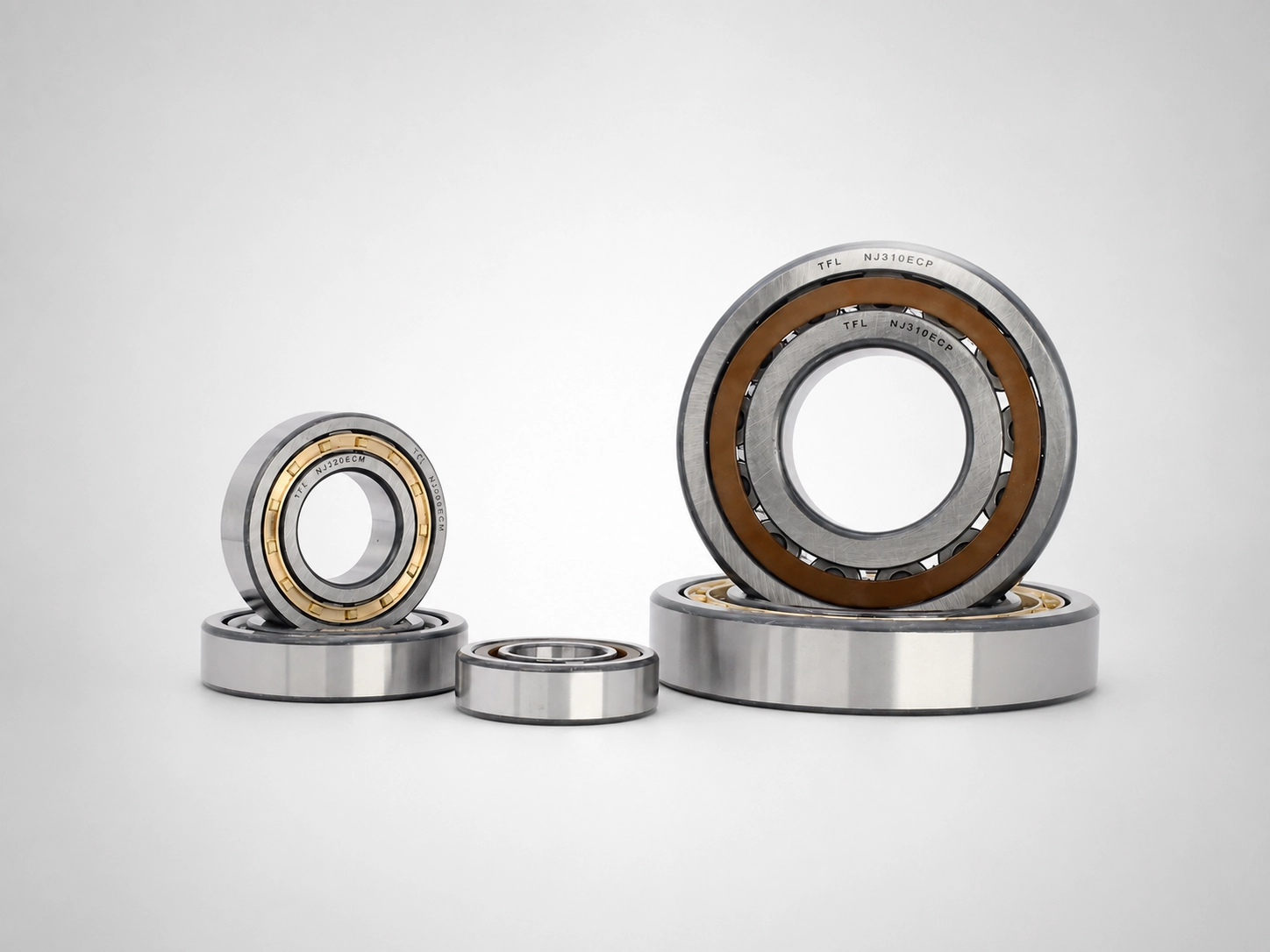
Two Different Solutions for Different Problems
Spherical roller bearings (SRB) and cylindrical roller bearings (CRB) can both carry substantial radial load, but their internal geometry and locating functions differ. The correct choice depends on the complete bearing arrangement, not only the load magnitude.
Quick Comparison
| Characteristic | Spherical Roller Bearing | Cylindrical Roller Bearing |
|---|---|---|
| Primary load type | Combined radial + axial | Primarily radial |
| Axial load capacity | Model- and arrangement-specific, often bidirectional | Depends on NU, N, NJ, NUP, or other design |
| Misalignment | Self-aligning within the selected model’s stated limit | Requires close alignment unless the arrangement provides compensation |
| Radial rigidity | Confirm by model and preload or clearance condition | Often selected where radial rigidity is important |
| Speed | Use the exact model and lubrication rating | Use the exact model and lubrication rating |
| Axial displacement | Depends on fit and arrangement | NU or N designs can permit displacement within the bearing |
| Separable rings | Generally non-separable | Several common designs are separable |
When to Choose Spherical Roller Bearings
Consider SRB when:
-
Misalignment or shaft deflection is expected: Check the selected model’s permissible misalignment and whether seals or nearby components reduce that allowance.
-
Combined loads are present: Calculate equivalent load with the exact model’s factors and confirm the arrangement’s axial locating function.
-
Shock or vibration is present: Compare cage, clearance, fit, lubrication, and application-specific design rather than selecting by bearing type alone.
-
A tapered-bore arrangement is specified: Confirm K or K30 taper, sleeve, drive-up, and residual clearance.
SRBs are used in many heavy industrial positions, but the industry name does not determine cage, clearance, or bore.
When to Choose Cylindrical Roller Bearings
Consider CRB when:
-
Radial rigidity is important: Compare calculated stiffness for the proposed models and operating clearances.
-
Speed and heat generation are central constraints: Compare published speed ratings, cage design, clearance, fit, and lubrication for the exact models.
-
Separable mounting is needed: NU and N type CRBs can allow the rings to be mounted separately, subject to the machine design and manufacturer instructions.
-
The arrangement handles axial location elsewhere: Confirm whether the CRB position is locating, non-locating, or supports limited axial load through an NJ or NUP design.
CRBs are common in gearboxes, motors, machine tools, pumps, and process equipment, but each bearing position needs its own load and locating analysis.
When NOT to Use SRB
- Do not assume self-alignment corrects poor shaft or housing geometry.
- Do not approve speed from bearing type; use the selected model’s rating and thermal analysis.
- Do not use a radial SRB as a substitute for a thrust-bearing arrangement without engineering approval.
When NOT to Use CRB
- Do not ignore alignment and shaft deflection limits.
- Do not infer axial capacity from the words “cylindrical roller”; confirm the exact design.
- Do not constrain thermal expansion unintentionally; define the locating and non-locating positions.
For comparison, send the current model, shaft and housing arrangement, radial and axial load, speed, temperature, fit, lubrication, required rigidity, quantity, and destination.